
Flint artist Pauly Everett brings Greek mythology to life in Detroit show
Pauly Everett’s new exhibition “From Greece With Love” blends Greek mythology with the rhythm and resilience of Flint.
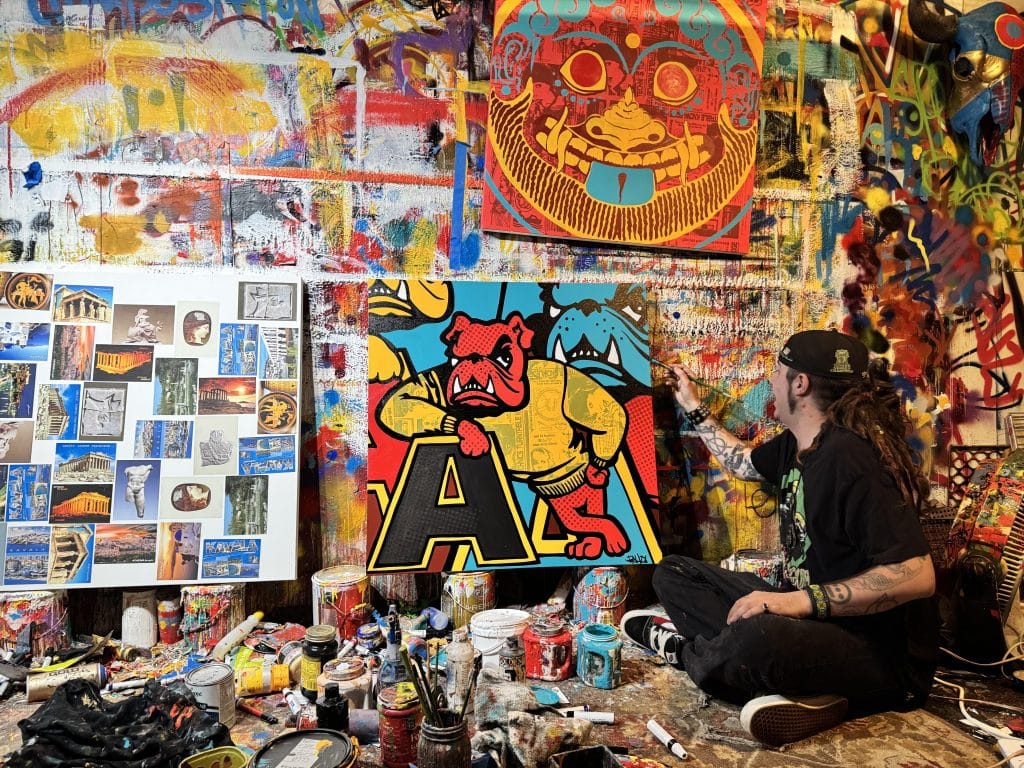
FLINT, Michigan — Color crawls up the walls of Pauly Everett’s studio, layer over layer, until the bricks disappear beneath years of work. Paint cans, brushes, and drippings from old paintings cover the floor, proof that the work never really stops. The room breathes with every new piece in a style that doesn’t feel forced; it’s rhythm, motion, and breath—a pulse that never quits. “I just paint every day,” he told me. “That’s all I know how to do.”
He’s been grinding since nineteen, when something inside him snapped into focus. “I realized I could make a better living off art than anything else,” he said. From pop-up shows on the sidewalk to group exhibitions and the rise of Flint Underground, Everett built a name the only way he knew how: by painting nonstop and helping others do the same. “Flint Underground cracked open in 2009,” he said. “It’s always just been the rotating crew of everybody that wants to push creative things forward. Family and community…get the art out there.”
The work became its own discipline. “Dedication is a thing,” he said. “Art has given me all these beautiful things in the world. It literally saved my life in a way.” He doesn’t pretend it’s a straight line. “You fail a million times,” he said. “From the smallest things like submitting to something and not getting accepted, but all those failures are beautiful oysters of learning.”
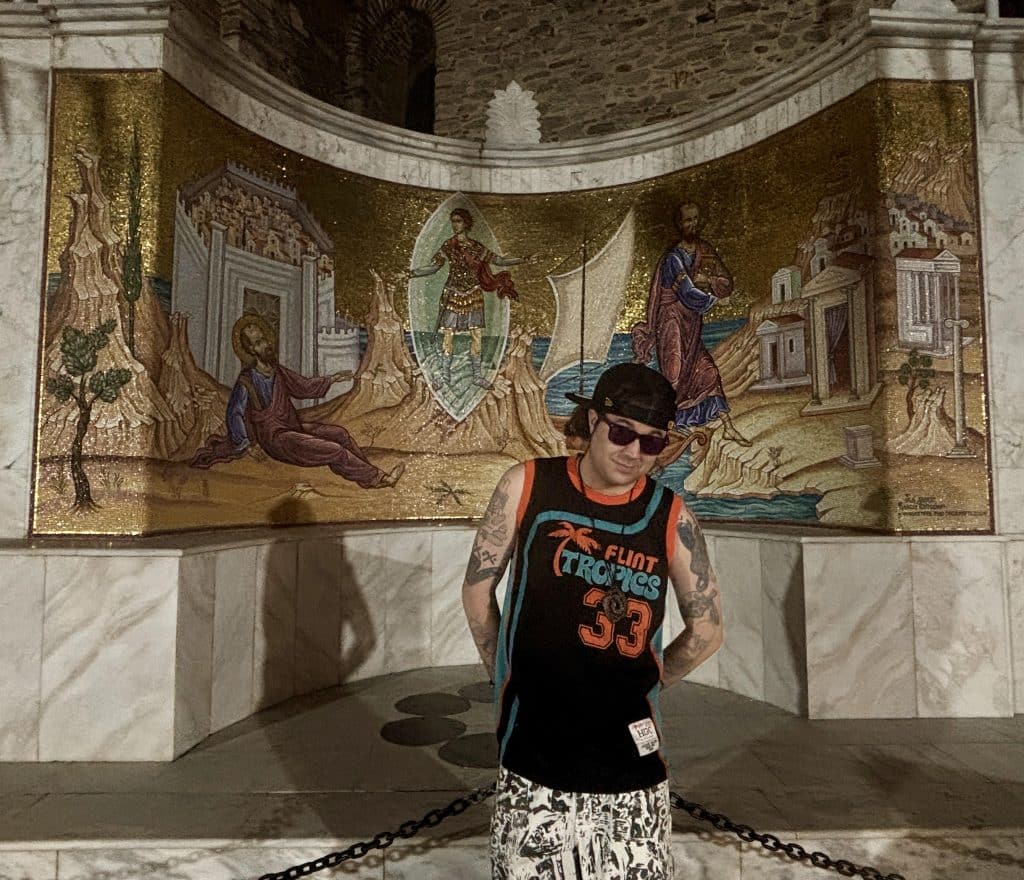
In 2025, that dedication took him halfway across the world to northern Greece, to the port city of Kavala for the Utopia Artists Residency. “As soon as I got accepted, I started the series,” he said. “I made art the whole time. Painted every day.”
The theme of the residency, sea and urbanism, felt like something that had been waiting for him. “It’s a port city,” he said. “They were doing what they could to get us inspired. I already had my own ideas.” He wasn’t there to escape Flint; he was there to see what happens when old worlds and new ones collide.
He dove deep. “I grabbed every single book I could possibly find on Greek art,” he said. “I study art just as much as I paint.” When he wasn’t working, he walked and took in the ruins, museums, and marble quarries. He remembers a cab driver pointing toward the mountains. “You see all that shimmery white stuff over there? That’s where they carve out the marble,” the man told him. “Now they got robots sculpting 3D-printed marble.” Everett laughed, shaking his head. “It blew me away,” he said. “You see where the masters started, and now it’s machines.”
The trip became a study in contrast—the sacred and the manufactured, the ancient and the digital, all sitting in the same light. “There’s something to be said about going back to the origins,” he said. “Who were these first artists and masters? I just try to learn as much as I can from the old masters, even like cave paintings and prehistoric sh*t. I love it all.”
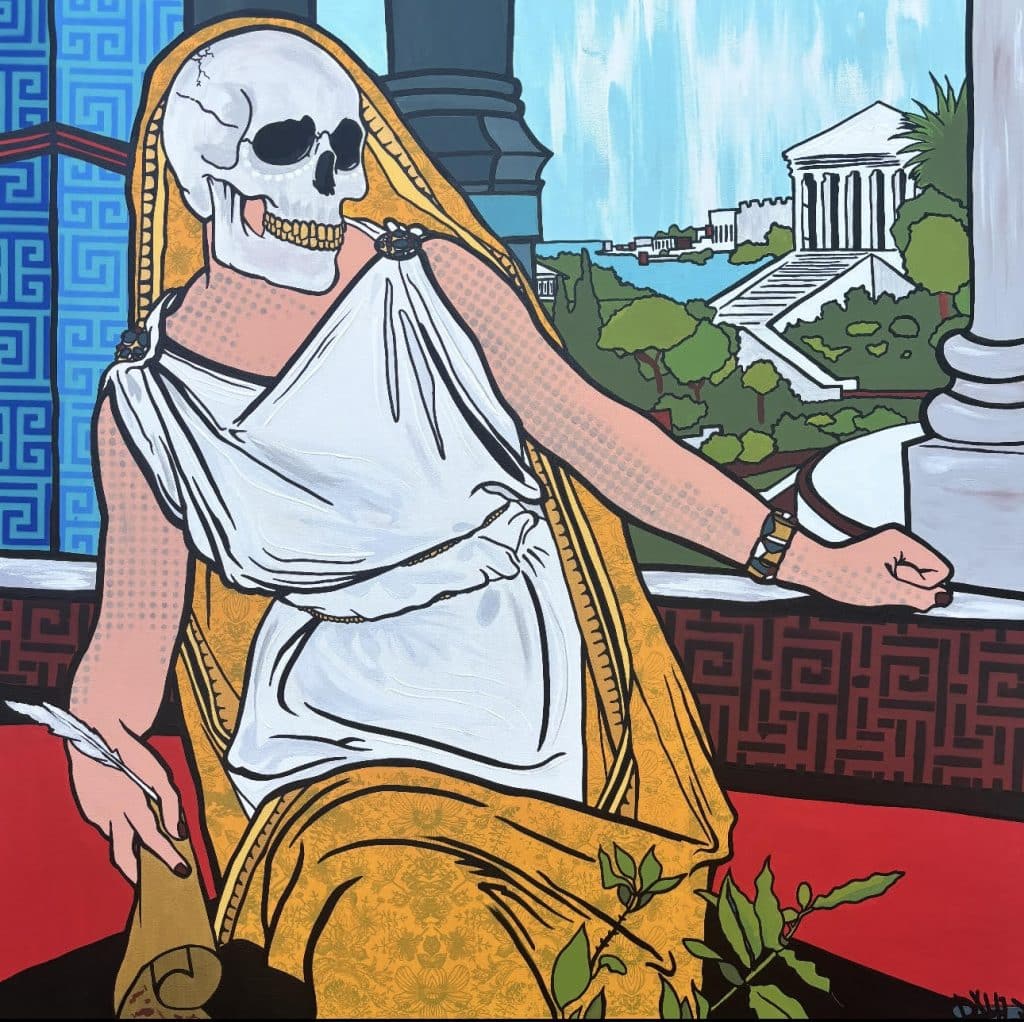
That curiosity became the foundation of his new exhibition, From Greece With Love, opening on Oct. 24 at the Hellenic Museum of Michigan in Detroit. The work he made before, during, and after Greece all spins around one question: how do old stories survive, and what happens when they get repackaged into something familiar?
“You think about Nike or Versace, Starbucks,” he said. “All these corporations and companies are logos stolen from Greek mythology. The alphabet, democracy; it’s already mashed so much together. Mash it up some more.”
In one piece, Achilles is painted onto a Wheaties box. “Don’t you want to be on a Wheaties box?” he said, laughing. “Everybody does.” The show blends mythology with modern branding, turning the gods of Olympus into pop culture icons. “There’s stuff collaged and hidden in the work,” he said. “Logos and different stuff that I’ve seen out there, too.”
Everett doesn’t approach this with cynicism. It’s more fascination than critique. He’s drawn to how symbols shift and survive, how they keep finding new forms. “It’s already all mixed up,” he said. “I’m just remixing it again.”
Athens became his second classroom. “I wasn’t just going to Kavala and coming back home,” he said. “I got to go to Athens.” A friend of a friend, a comedian from the Bay Area, found him a wall to paint. “It was so hot out,” he said. “I painted at night, pretty much every damn day I was there.” He laughs about it now, remembering the sweat, the concrete, and the sound of the city. “I got some art in Athens,” he said. “Some in Kavala, some in Mexico City. You create when you’re depressed, when you’re happy. You still make art all the way through.”
When he came home, the Greek work didn’t stop. “I think I did a count the other day,” he said. “It was like twenty-six Greek paintings in the series.” He started as soon as he got accepted into the residency and never really stopped. “It’s not even planned out,” he said. “I’ll just start it. Just go.”
The Hellenic Museum show came together in classic Pauly fashion: persistence, luck, and hustle. “I saw a call for Greek artists,” he said. “It was for Greek artists only.” He waited for it to close, then sent an email explaining the residency and his family heritage. “They hit me back,” he said. “They were like, we met you before. We love your work. Want to do a solo show?”
He still seems surprised by it. “As soon as the date was locked, I was like, oh sh*t. I could take everything I started from since I got accepted—the residency, everything I made there, plus the murals, plus everything I do when I get back up until Friday, Oct. 24. I’ll just stay on the theme until then. I’ve never been on a theme this long.”
The work carries Flint in its DNA—the grit, the layering, the make-do resourcefulness. Greece didn’t erase that; it gave it more context. “Each piece has its own story,” he said. “There’s the story of what I was feeling when I did it, and then there’s the context of what you’re looking at.”
What makes Everett’s art magnetic is its honesty; the sense that the surface has lived a life before you ever see it. “I want my paintings to have that same kind of energy,” he said, “like they’ve been through something.”
In From Greece With Love, that energy feels expanded—the mythology of a culture layered with the mythology of a city, the gods of Olympus reimagined through the lens of Flint’s working-class soul. “I’m not Greek, and I got a solo show in a Greek museum,” he said. “People might get pissed off. I don’t know. But I want people to have a good time. To think about things. I want people to feel feelings,” he said.
For younger artists, his advice is as stripped-down as his process. “Be your own shiny light,” he said. “You’re one of one. There’s no other you. You got to be the best you there is. Especially if you’re an artist, because there’s so much watered-down, boring nonsense going on in the world. If everybody was just a hundred and ten thousand percent themselves and experimented more, had fun, went and traveled, seen the world, and figured out a way to persevere through the bullsh*t and just create, we’d all be having the best time.”
He means it. After Greece, he’s already looking toward the next challenge. “I’m going to study down in Austin, Texas,” he said. “Mosaics. I want to learn new techniques and see how my work translates to different mediums.” He talks about it like a kid waiting to open a new box of paints.
Before I leave, he circles back to the same idea he started with. “Art is universal,” he said. “Going into all these different spaces just helps me shatter whatever boxed ideas I thought I might have known.”
Then he shrugs, smiling, the way he does when words start getting in the way of work. “I just paint every day,” he said. “There’s always something new in the layers.”
‘From Greece With Love’ opens Friday, Oct. 24, at the Hellenic Museum of Michigan in Detroit. The exhibit runs until Dec. 31. Stay connected to Pauly by following him on Instagram and Facebook.
Related Articles
Inclusion Takes the Center Stage at Flint Community Players
Flint Community Players center inclusion by rethinking how theatre audiences experience performances.

Shanzell Page brings rhythm and legacy to Flint as UMS/UM-Flint Artist in Residence
Flint-born tap artist Shanzell Page returns home, blending movement, memory, and legacy as UMS/UMFlint Artist in Residence.

Why Flint Needs a Comedy Home—and Why JeCorey Hawkins Is Building It
JeCorey Hawkins is rethinking what comedy can look like in Flint, pushing for consistency, space, and a scene to call home.


