
Punk rock band May/June returns to celebrate Flint Local 432’s 40th anniversary
May/June is making their long-awaited return to Flint, bringing their punk rock energy back to celebrate the venue where they built a loyal following.
Written by Brian Stout
FLINT, Michigan — It’s no secret that Michigan has long had a seemingly endless supply of talented musicians, but without places to play, there is no pipeline for the artists to cultivate followings. People like Joel Rash keep local scenes alive by booking house shows and running clubs to make it possible for bands to find an audience.
This year, Flint Local 432, the all-ages music club, is celebrating its 40th year. All across the country, venues like the Local run for a few years and fade away, but the dedication of the bands and the patrons has kept all-ages music accessible to Flint for decades, enduring the occasional break and multiple venue changes.
For forty years, Rash has hosted hundreds of legendary punk bands, including Fugazi, Superchunk, and Dismemberment Plan, but the Flint punk scene thrives week to week by attracting top-tier locally-grown and regional artists and by staying committed to being all ages and fairly priced.
And the consistent presence of all ages live music in downtown Flint ensures there has been a never-ending loop of people seeing bands and then starting their own bands. Many bands that have graced the Local’s stages have gone on to much bigger things, but even then, many remained committed to coming back, even when they could have played a much larger venue.
As anyone who has been to a few shows knows, once you have been there, the Local gets into your DNA, and you become part of it. You might work the door or help with setup or tear-down. You might come to a cleanup day. You might start a band (like many of my friends) or a (short-lived) zine, as I did. You might do all of those things. And later, it might turn into more opportunities, like writing an article about the club that facilitated you finding lifelong friends and finally feeling like you’ve found a community.
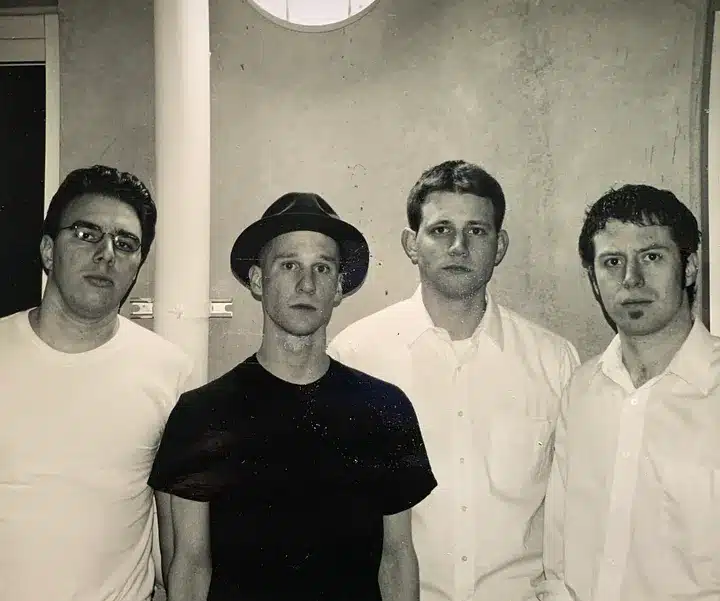
For the members of May/June, who are playing together for the first time since 2002 as headliners of the 40th anniversary celebration of Flint Local 432, the club was initially a source of inspiration, and over time and across several projects, the band has found itself influencing other people to start playing and be unafraid to color outside the lines of punk.

“I found out about the Local because we went to high school with Wes Keely, who was the drummer for [local 1990s hardcore band] SPIT. Wes had been playing some shows at the Capitol Cafe downtown. When the Local started doing shows at the original 432 space, we all went to the opening weekend. I think the first show I saw was SPIT, Power On Hold, and a few others. My first reaction was feeling both kind of starstruck and overwhelmed, but also at home. Power On Hold was doing something incredible on stage in front of me, but it was also a place that I could imagine myself being able to play. I didn’t get that feeling when I would see touring bands play bigger stages in Detroit. Since we had a band, and this was a ‘real’ place to play, we immediately started talking to Joel, trying to get put on a show, and I think we got on stage a few weeks later,” lead singer and guitarist Stephen Wisniewski recalled.

He continued, “I think that what maintained that feeling of being at home through the years that followed was the community that got built around the idea of the Local, even when it would change locations. It was a place where you could try anything and still be supported. Anybody was just as likely going to be working sound or running the door as they were going to be on stage any given night. You also probably helped build the stage. It actually felt like ours in a very real way that’s very difficult to create, much less maintain for 40 years. I think that could’ve only been created in a place like Flint, at a time when nobody else cared what was happening downtown.”

The band includes Wisniewski, drummer Mark Maynard, bassist James Plouffe, and multi-instrumentalist Ryan Buell, who plays guitar, accordion, banjo, and piano. They started playing together in 1994 in their first band, Minefield Hopscotch. They took a break after that project, and started playing together in a basement as May/June in 1999. From the start, the band’s punk spirit was channeled through their collective interest in other genres. May/June will be celebrating an anniversary of their own, too, the 25th anniversary of their debut release, The Sea is Filled with Horrible Fish. Their releases are available on Bandcamp.
“We recorded The Sea in a studio we built in a barn on Ryan [Buell]’s family’s property. For some reason, or perhaps because we didn’t know the other possible paths, we decided we should build our own studio and make the record there. That was us saying to ourselves that we were going to do this our own way, even if it was outside of the established paths. We were interested in building our own structures,” said Wisniewski.
“I think back to something our friend Mat Burleson said. He called us ‘folk music from another universe.’ I always liked that,” Plouffe added.
And that commitment to charting their own course also applied to music. No influences were off limits.” There were artists like Tom Waits and Morphine, of course, but I grew up listening to my dad’s polka albums, and I was really influenced by 1980s and 1990s hip hop, as well as stuff like Rankin and Bass’ animated version of The Hobbit and the soundtrack for the Garfield Halloween special. In a genuine way, I think that all of that made sense to me as vibes that I wanted to evoke in serious songwriting, which is why nothing seemed ‘wrong’ or off-limits in terms of influences when we started writing for May/June,” Wisniewski said.
Maynard added, “We were trying to approach music and songwriting in a way that felt natural to us as a group. Stephen would have chicken scratches of lyrics and song ideas in a notebook, and then someone would decide the song needs a horn. No one had a horn, so one of us would play their instrument like a horn. I kept thinking Dick Van Dyke and Mary Poppins. We were into weird orchestration.”
“We started Minefield Hopscotch when we were literally children, so we had this band that didn’t reflect us anymore. The demos for the first May/June record were us exploring different genres,” Wisniewski said. “Punk is folk music. We came from an outside perspective, but it was grounded in those same values.”

And while many other bands in the scene at the time were covering the lyrical staples of punk and emo, lost and found love, politics, and friendships, The Sea is Filled with Horrible Fish went in a different direction, with songs like “Stealing Chaplin” and “All Along the Way,” songs that tell stories and recall artists like Tom Waits. May/June blazed a trail. A couple years later, bands like The Decemberists were mining similar ground and achieving significant mainstream success.
For those who weren’t there, picture this, then think of it captivating an audience of young punk fans. “We had an accordion, banjo, steel guitar, electric piano, trash cans or other unusual percussion; we would often dress in stage clothes like suits or work uniforms; we’d sometimes bring our own stage lighting for atmosphere,” Wisnieski recalled.
That era of the Local was a particularly fertile and diverse period of time, with peers like Kid Brother Collective, Kinetic Stereo Kids, and Chicago’s Oh My God delivering a wide range of styles that packed the Local, and no one would step outside during the sets when these bands played on the same bill.
“We have all run into people who told us that our band made them want to play music. Sometimes you’re in a band and you aren’t sure what else you can do with it. But we had the opportunity to play with our friends, be on stage. When Guitar Hero got popular, I hoped it would do the same thing that the Local did,” Plouffe said.
“We were also a model. We weren’t the type of musicians you’d usually see on punk stages. We were the only band around that had instruments people hadn’t seen before. It was important to me. Nothing we did was meant to be gimmicky. It was more that we were open to whatever tools we had at our disposal to make the songs we wanted to make,” Wisniewski said.
Much like the bands they inspired, they had a north star whose experimentation and restless creative spirit challenged them to be the best version of themselves, rather than emulating someone else’s sound. “In the heyday of all ages shows, a north star was always Fugazi. We all love Fugazi so much. Wouldn’t it be cool to be them? But no one can do that. But instead, we were ourselves and we wrote the songs we wanted to write,” Maynard said.

And while May/June was only around for a brief period of time, there were other projects after. Next was Lingua Franca, with Wisniewski, Maynard, and Plouffe experimenting with their sound even more, taking it to uncharted territory. Wisniewski and his partner Pam Butler would go on to the Americana-tinged Empty Orchestra, who have an explosive song honoring the Sit Down Strike. Wisniewski is a student of Flint culture and history, and it has been a near-constant theme across all of his work.
He designs and builds exhibits for children’s museums and writes about the history and cultural politics of Rust Belt cities. “Those things are directly influenced by my experiences with the Local, and I ended up writing my dissertation largely about Flint,” he said. He also led BRAIDEDVEINS, which is a hardcore/noise band, and he’s currently recording with another local luminary, acclaimed producer Marc Hudson, for a project called Unison.

Flint has definitely changed a lot since the days when May/June was playing the Local regularly. The artist communities in Detroit and other blue-collar Rust Belt cities revel in the freedom that “downtrodden” cities offer.
“When we started playing downtown, Flint was weirdly accessible. You could explore the city because it was usually pretty empty except for the Local and the bar crowds. Flint is pretty punk rock as a town–scrappy. And we all grew up in the suburbs, which is boring,” Plouffe said.
“It was exciting to come to the Local on the weekend to see shows or play shows. And after, climb fire escapes and such. The post-Roger and Me era of Flint was sparse and free. There was something really empowering about that. I never thought about the danger too much, because it was so much fun. The community of artists needed a place to congregate and interact and that was the Local,” Maynard said.
“I think this applies to lots of places similar to Flint, too, but especially at the time that the Local started. There is an aesthetic to being undesirable. There is something that happens culturally when you are left alone. James and I lived at 625 S. Saginaw St., and that’s where we recorded all of [second release] Field Recordings. I think it’s an example of just how much the city was infused into our being as a band. We wanted that record to literally sound like where we lived; it was all recorded in the big, abandoned spaces of that building, and we didn’t use any artificial effects. All the artwork was from the 100-year-old destroyed scraps of wallpaper around us. It also grew lots of weird mushrooms in the stairwell, and toxic mineral crystals in the basement, and that’s kind of how I imagine May/June,” Wisniewski said.
He continued, “When you leave something alone, weird things can grow. I think about our band in terms of that environment. It’s important that people of all ages have spaces like that. I hope there are things going on that I will never know about. I hope I never live in a neighborhood where it’s not okay to have house shows. Being able to make a culture out of a community is so important. It made me who I am and continues to make me who I am.”
“Always hire a punk rocker. They know how to figure it out. Punk rockers know how to grind,” Plouffe said.

May/June is in preparation for the anniversary show at the Local, and they are taking the excitement of playing together for the first time in quite a while in stride. “We’ll see who still cares about May/June when we play the show. It’s cool that we got to be part of the scene and to make the connections. We were lucky. But also, people still need spaces like that, and younger generations certainly need it. It’s better than doomscrolling. Go to a punk show. Ram into some people in the pit. What I hope is that we are part of a tapestry. I’m more interested in what continues to happen than us getting on stage together,” Plouffe said.
“Show trades, other all-ages spaces, communities, sleeping on people’s floors…all of that builds an intense sense of gratitude that we were able to be part of that, and we hope it remains possible for others to keep doing that, too,” Maynard said.
“I think what’s actually powerful is communities of weirdos being weirdos together, and feeling invincible and supported in spaces of their own making. I also feel like oppositional culture was an important part of that scene at that time, building something that was not for everyone, and not attractive to a mainstream world, in the same way that a mainstream world was not attractive to us,” Wisniewski said. “I love that the Local is powered by a spirit that was built by a bunch of people without sponsorship or supervision, with whatever pooled resources are around.”
Reunion Show Info:
Location: Factory Two, 129 N. Grand Traverse St., Flint, MI 48503
Date + Time: Saturday, Aug. 23. Doors 6:30 p.m., Show 7:00 p.m.
No Cover, all-ages welcome
To check out May/June’s music, visit: mayjune.bandcamp.com
Related Articles
Pressing Record: Ace Gabbana and the Stories That Built King Mondo T.V.
Ace Gabbana reflects on family, memory, and growth in his most personal album yet.

Step Afrika! Brings Rhythm, Heritage, and History to Flint
Step Afrika! brings the cultural rhythm of stepping and African American heritage to Flint.

Tyler Farr brings ‘Quit Bein’ Country’ tour back to Flint’s Machine Shop
Country star Tyler Farr returns to Flint’s Machine Shop while promoting his new EP.


