
George Lopez on Legacy, Instinct, and Taking the Stage in Flint
George Lopez reflects on comedy, resilience, and trusting your instincts ahead of Flint show.

FLINT, Michigan — How does one attempt to encapsulate a career spanning more than four decades in just twenty minutes? The question lingered heavily at first, until those overwhelming nerves softened into a steady current of energy—charged with reflection, laughter, and anticipation ahead of George Lopez’s upcoming performance at the FIM Capitol Theatre on May 7, 2026.
What stood out almost immediately wasn’t just the legacy, but the man behind it. There was no ego. Before a single question was asked, Lopez thanked me for my time—an unexpected gesture that quietly explained his longevity in an industry known for its sharp edges.
“You got to get out of your own way, but also you have to trust the fact that what you are thinking is right for you,” Lopez says as he reflects on his humble beginnings.
Throughout our conversation, Lopez returned to a simple but enduring philosophy: trust your instincts and see things through. It’s a mindset that has carried him across decades of change, from stand-up stages to television and film, and now into a new chapter—one that includes working alongside his daughter while continuing to evolve his craft. If anything, he made it clear: stepping away from the stage isn’t part of the plan anytime soon.
Flintside: When you step on stage now, what feels different from the beginning, like your early days?
G. Lopez: “There’s no way that you can get better without it hurting you, deflating your ego, or whatever was unexpected. You don’t make the mistakes that you did when you were young, and learn that you will never get the same audience twice.”
Flintside: What has that been like, to be the dreamer and now the creator? Was there any type of imposter syndrome? How did you navigate that?
G. Lopez: “I’ve sat down and thought about my life often. I thought of everything that I’d done that was difficult to do. I used to always quit. And me and my coach had words after calling me out for quitting [when things got tough]. It was probably, maybe four or five years after I graduated from high school, [that] I went to my high school. There was baseball practice.
I waited until all the baseball players went in, and my coach was hanging back. I walked over to him. He hadn’t seen me. He’s like, ‘Hey. What are you doing here?’ I said, ‘Oh, I came to apologize to you for the way that I treated you when I was in school.’ And he couldn’t believe it. I could not have lived my life disrespecting him and go on knowing he kind of gave me the key to the rest of my life.”
Flintside: Do you think humor heals, or do you think that it just helps us cope?
G. Lopez: “If you lose your sense of humor, then I think that maybe your personality is kind of shutting down. Because my grandmother would come into a room where people were laughing and say, ‘You guys better not be laughing about me,’ and it would kill the mood. Not having a sense of humor can stop relationships or end conversations [prematurely]. It’s coping. I think the healing comes maybe when you’re able to [seek help], go see a psychiatrist, or be in therapy.”
Flintside: Did you always intend to represent the Latino experience? Or did it evolve naturally?
G. Lopez: “Yeah, in the beginning. I think in the beginning, you don’t even realize you’re trying to talk for a certain group of people. There’s very few of us here. I always stood out a little bit different from everybody else because of the way that I looked. In the early nineties, this guy came to see me. And afterward, he said, ‘You know, I don’t know what you’re about. I don’t know where you are politically. I don’t know if you’re married. I don’t know if you have a kid.’
So it’s very mundane, very superficial. He says, ‘You know, when you see Chris Rock, you know what Chris Rock is about. You know what he likes, you know what he doesn’t like, but when I see you, I don’t know any of that.’ And that little piece of constructive criticism changed the rest of my life. I started to focus on my grandmother and talk about things that were personal to me.”
Flintside: Flint is resilient and has been through a lot. Does that influence how you talk to this audience on May 7th?
G. Lopez: “I think Flint people are very resilient. And I remember we did the Comedy Get Down show there, and something flew by me. I said, ‘Did something just fly by me?’ and we all started laughing. It was a fucking bat in that little arena. I think everybody but me knew that there’s bats in that arena. [But seriously] when things are bad, Flint just doesn’t accept it and settles for less.”
Flintside: Do you feel like the best is yet to come, or have you already experienced the best within your career?
G. Lopez: “I’ve done a lot of stuff. I would say anything else that comes would be like playing with house money. I can’t say the best is yet to come, but if something good comes, I will appreciate it as I always have appreciated the great things that’ll happen to me.”
Flintside: Any advice for any up-and-coming comedians?
G. Lopez: “If you are a comedian and you’re learning, you get on that stage. Three to five minutes seems daunting until the only thing you can replace insecurity with is experience and confidence. When I go watch a young person, they take the microphone out of the stand, and they leave the stand where it is, and you’re like, the fucking guy’s gotta move the stand, you can’t see them. So that kind of stuff, the little things, when you’re nervous, you don’t see [certain things], and everybody else sees them. Go into any new job like you know nothing and let them educate you.”
As George Lopez prepares to take the stage in Flint, his message is as clear as his legacy: keep showing up, trust your instincts, and let the work speak for itself. For those ready to experience an evening shaped by decades of honesty, humor, and resilience, his May 7 performance at the FIM Capitol Theatre promises just that.
To attend the show, purchase your tickets today, and follow his official website.
Author

Related Articles
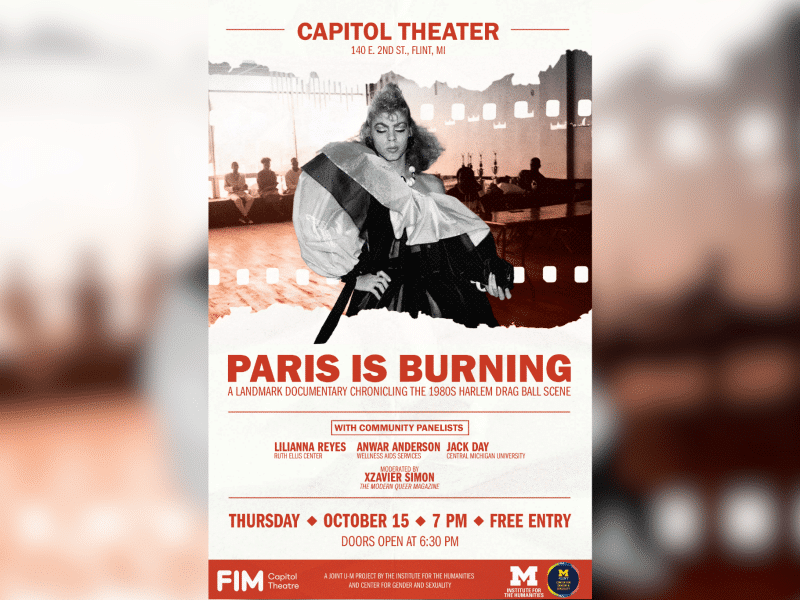
Free “Paris Is Burning” Screening and Panel Coming to FIM Capitol Theatre Oct. 15
Free screening of ‘Paris Is Burning’ with a panel discussion comes to Flint’s Capitol Theatre Oct. 15.

Vehicle City Film Festival Set to Celebrate Michigan Filmmakers and Flint’s Film Community
Vehicle City Film Festival brings screenings, talkbacks & awards to Flint Oct. 1-3.

FIA to Host “Splendors of South Asia” Cultural Celebration
FIA hosts ‘Splendors of South Asia’ cultural celebration Oct. 3 with food, music and dance.